Software architect · .NET · 20+ years · GMT-3
I design and build complex business systems in .NET.
Architecture and hands-on delivery from a systems engineer who has spent two decades inside real businesses: I’ve designed and rolled out management systems at more than 20 companies.
I build and run what I design.
Services
How I can help your team
Discovery, assessment & roadmap
Before anything is built or replaced: I map the domain and the current system, assess its architecture, data and risks, and deliver a staged roadmap (build or migration) your team can execute without stopping the business.
Business systems & integrations, end to end
From discovery to production: I model the domain, build the full-stack .NET application and connect it to everything around it (APIs, existing systems, government services), so data flows instead of being retyped.
Modernization & replacement
I rescue, harden or replace existing systems: performance, architecture, tests, observability and CI/CD, with incremental migrations that keep the business running. Without a big-bang rewrite.
Is your case different? Book a call →
Career
Twenty years solving the business, not just the code.
Developer .NET · international clients
Backend and full-stack for UK, European and US clients, in multicultural teams distributed across several continents and time zones. Maintaining and evolving complex, large-scale systems: a mobile-connectivity (IoT/M2M) platform with real-time event pipelines (Kafka/RabbitMQ), a clinical case-management system under GDPR where I have been lead developer since 2023, and a cloud email/messaging SaaS on AWS microservices. .NET Framework through modern .NET, plus Node/TypeScript and PHP where the codebase required it. Alongside this, I build my own and freelance .NET projects (see Selected work).
Freelance developer & architect
I designed, built and operate a multi-tenant SaaS business platform on .NET 10 and Blazor, running a full ERP with tax-authority e-invoicing (see the case study). I also built a medical-appointments app with SMS and WhatsApp reminders.
Founder and developer of an ERP for SMBs
I designed and built an ERP deployed at more than 20 companies. I gathered each client’s requirements, led the implementations and supported the teams through adoption, understanding in depth how each business operated. I also migrated legacy systems from Visual Basic to .NET and moved client databases from Microsoft Access to SQL Server and PostgreSQL while the businesses kept operating.
Technical support
I worked with the support team and on ERP implementations at mid-sized companies. I built a ticket management system that improved response times by over 300%.
Flagship case study
A platform to build business systems on
.NET 10 · Blazor · Dapper · Clean Architecture
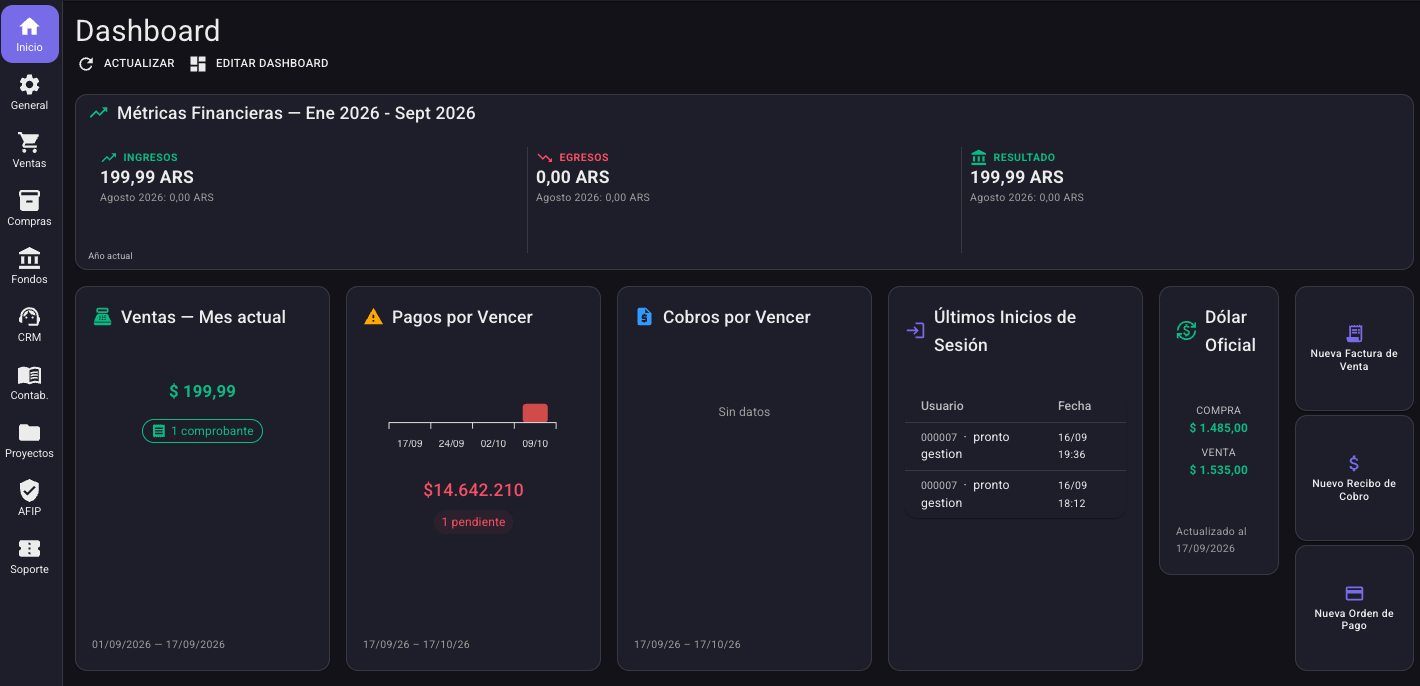
Everything I learned rolling out systems at real companies went into a platform I designed, built and operate. A full multi-company SaaS ERP runs on top of it, but the real asset is underneath: a reusable kernel and pluggable modules that other systems are built on. The platform’s own admin console already runs on that same foundation.
A platform, not an app
A reusable kernel plus a module contract (IPlatformModule) that declares services, tables, navigation and the ports it needs from the host; if one is missing, the app refuses to start. Six platform modules (messaging, tickets, audit, approvals, signed share links, command palette) shared by two different systems. Database-per-tenant, even engine-per-tenant.
Integration-first
A REST API with hashed, revocable tokens so existing systems can read data and push records and messages. An HMAC-signed machine-to-machine channel with a timestamp window, per-key rate limiting and idempotent upserts. National tax-authority and central-bank services (e-invoicing, taxpayer lookup, tax withholdings) behind adapters with a circuit breaker; templated SMTP email.
Portable data, real quality
Full per-tenant export to JSON, Excel/CSV/PDF exports, dry-run imports and compressed per-engine backups to S3: customers are never locked in. More than 4,300 automated tests (xUnit, bUnit, integration, Playwright), OpenTelemetry and .NET Aspire.
- Lines of C#
- ~400k
- Automated tests
- 4,300+
- Pluggable platform modules
- 6
- Systems on the same kernel
- 2
- Government web services
- 5
- Built as a platform
- extensible
Stack & engineering
Architecture
Platform
Data & infra
Integrations
Selected work
An enterprise prepaid platform in the mobile-connectivity sector (UK): a distributed system that connects the commercial side (network operators, resellers, products, billing accounts and top-ups, exposed through an OAuth 2.0 API with partner webhooks) with the mobile network core that provisions SIMs, authenticates them and reports usage in real time.
I work across the estate: the commercial API, the real-time usage-event pipeline (Kafka with Avro and Schema Registry, RabbitMQ), SIM stock and provisioning, and support tooling. I hardened business-critical flows with durable retry queues and recovery workers (SIM activation, top-ups, partner notifications), replaced risky manual SQL operations with audited features, remediated security findings (Snyk), and led the analysis and estimates for migrating provisioning to a new mobile core (Nokia SDM) while both cores coexist.
The result: a business-critical billing and provisioning platform that keeps evolving, and keeps getting more resilient, without disrupting service.
A clinical client-management system for a UK healthcare non-profit, covering the full client journey: referral, intake, clinical assessment, therapy, multidisciplinary decisions and medical-legal reports, with role-based access, Active Directory integration and full auditing.
Lead developer since 2023, working directly with the client’s product owner from requirements and estimates to delivery and production support. I migrated the data layer from Entity Framework to ADO.NET repositories and rebuilt the history/audit logging to fix performance; delivered new clinical workflows, medical records, reporting (SSRS) and the web-referral intake pipeline (PHP/Symfony integration API); and designed the GDPR data-retention system: rule-based retention, automated deletion, anonymized statistical records for reporting and an audit trail for every deletion.
The result: a faster, actively evolving system, with GDPR compliance automated end to end.
A SaaS platform for email tracking, sending and design for internal corporate communications, embedded in email clients (Outlook, Gmail) and a dedicated web app. It covers contact and list import/management, bulk-broadcast sending and tracking, scheduling, and a drag-and-drop email builder.
A microservices architecture on AWS (ECS/Fargate + Lambda), Node.js/TypeScript (Hapi, Express, NestJS), a React/Redux frontend, SQS/SES messaging and Aurora MySQL, DynamoDB and Redis. I worked across a heterogeneous estate, migrating legacy services (Hapi/Node 12) toward modern stacks (NestJS/Node 20).
The result: legacy services modernized incrementally, without interrupting sending or tracking in production.
Support, maintenance and enhancement of business-critical, high-availability applications for a US energy company (power generation and retail electricity & gas supply). The systems cover demand and price forecasting (forward curves), weather profiles, a cost engine and market data, within a remote, multidisciplinary and distributed team, with ITIL support and on-call rotations.
I refactored .NET applications for performance, designed and deployed a .NET application to consolidate data across cloud databases, adapted the data layer to Oracle, and wrote internal technical documentation and specifications.
The result: faster, more stable applications and data reliably consolidated across systems.
A personal appointment-management app with automatic SMS and WhatsApp reminders (Twilio). Full-stack .NET 8: a Blazor WebAssembly frontend (MudBlazor), an ASP.NET Core backend with JWT, MongoDB persistence and message templating, containerized with Docker.
The result: fewer missed appointments thanks to automatic reminders.
Regulated domains
Where compliance is part of the spec.
Most of my work has been in domains where wrong data is a legal problem, not just a bug. Different regulators, same discipline: least-privilege access, audit trails, and data you can account for end to end.
Healthcare data · UK, GDPR
Lead developer since 2023 of a clinical case-management system for a healthcare non-profit: special-category health data with role-based access and full auditing. I designed its GDPR retention system: rule-based retention, automated deletion, anonymized statistical records and an audit trail for every erasure.
Tax authority & e-invoicing
Every invoice the ERP issues is authorized in real time by the national tax authority’s web services and generated as a PDF document; VAT books and withholding regimes are exported in the formats the authority mandates. A wrong figure there is a fine, not a ticket.
Telecom billing & provisioning · UK
A prepaid mobile platform where usage reported by the network has to end up correctly billed: an OAuth 2.0 API for operators and resellers, real-time usage events (Kafka/RabbitMQ), and durable retry and recovery for SIM activations and top-ups.
Energy markets · US
Business-critical, high-availability systems for a power generator and energy retailer: demand and price forecasting, a cost engine and market data, run under ITIL processes with on-call rotations.
Engineering decisions
How I think about trade-offs.
01Dapper over EF Core, on purpose
An accounting ERP is dominated by reporting queries and runs on SQL Server, SQLite and Turso. Dapper gives full control over the SQL; an in-house schema catalog generates each engine’s DDL and a dialect layer absorbs the differences.
Trade-off: more SQL and more in-house tooling to own. For CRUD-heavy apps I still reach for EF Core.
02Thousands of tests that stay fast
Tests only pay off if they run on every change. The bulk (about 3,400 unit and component tests) gates every push in CI; integration and Playwright E2E cover the critical flows outside that fast path.
Trade-off: the slow suites don’t gate every push, so the domain has to be testable in isolation. That’s exactly what Clean Architecture buys.
03A tax-authority outage never blocks a sale
The national tax authority’s services (e-invoicing, taxpayer registry, withholdings) and the central bank sit behind their own adapters with a circuit breaker. If e-invoicing authorization fails, the invoice stays issued and the authorization is requested later, with no rollback.
Trade-off: intermediate states the business has to see and resolve. Better than a stalled checkout.
04Retention as rules, erasure with a receipt
In the clinical system, GDPR retention is not a manual chore: rules decide when personal data expires and whether it is anonymized or deleted, and every erasure is written to an audit trail. Compliance you can prove, not just claim.
Trade-off: the rules have to evolve with the schema. A new personal-data field nobody maps is a silent gap, so the rules get reviewed like code.
About me
A systems engineer who enjoys the domain, not just the code.
I’m a systems engineer with over twenty years working side by side with companies: I map how they operate, understand their business and turn it into software. I’m comfortable where the domain is hard: tax rules, double-entry accounting, multi-company.
Full-stack for real: I model the domain, write the API, build the UI, choose the database and set up observability and CI/CD. I like to understand the problem deeply and leave an architecture others can extend.
Where I’m strong
- Requirements & business analysisneeds · processes
- Backend architecture .NET / C#Clean Arch · DDD
- Frontend Blazor / componentsWASM · MudBlazor
- Database designSQL · multi-engine
- Third-party & government integrationsAPIs · tax & e-invoicing
- Testing and qualityunit · integration · E2E
- Infra and cloudDocker · Azure / AWS / GCP
Contact
Shall we talk about your next system?
Drop me a line or book a 25-minute call. I reply fast.
Remote · GMT-3 — working hours overlap with the US and the Americas